
Antonelli E, Wildhaber BE, Pfister RE, Department of Obstetrics (AE) and Department of Pediatrics (WBE, PRE), University Hospitals of Geneva, Geneva, Switzerland.
Published: January 1, 2005
Introduction
A giant umbilical cord is a very rare malformation of the umbilical cord that can easily be diagnosed on prenatal scans and is unmistakable postnatally. We present a typical case with extensive iconography to demonstrate aspects of this rare diagnosis relevant to obstetricians, neonatologists and also parents of patients with this malformation.
Case report
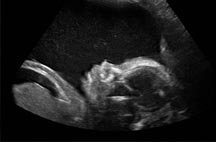
Prenatal history: In a 37-year-old G2/P1, with an unremarkable medical and obstetric history, routine ultrasound (US) at 20 weeks of gestation revealed a live singleton fetus with two anechoic umbilical cystic masses (measuring 30 and 20 mm in diameter) at the fetal insertion site (Fig. 1A). Ultrasonographic color Doppler imaging confirmed normal flow through two umbilical arteries and one umbilical vein (Fig. 1B; movie). The vessels were clearly separate from the cystic masses. The umbilical cord insertion on the fetal abdomen appeared normal and no other anomalies were noted. A connection between the cysts and the fetal bladder was not apparent (Fig. 1B). The amniotic fluid index was normal. Serial US examinations at 28, 32, 34 weeks gestation documented appropriate fetal development. The size and the number of the cysts increased. On the last US performed at 37 weeks gestation five large umbilical cysts were apparent, measuring between 30 and 70 mm in diameter. An emergency cesarean section was performed at 39 weeks of gestation because of repeated fetal bradycardia after spontaneous labor had started. Membranes were still intact and amniotic fluid was clear.
 |
 |
 |
|
Figure 1. Prenatal US scan:
A) View of the umbilical cord with several large cysts in Wharton’s jelly. B) Section of abdomen with bladder and umbilical vessels. |
Movie.
Prenatal ultrasound |
Figure 2. Postnatal appearance of the umbilical cord: large, lobulated and transparent umbilical cord with unusually large cutaneous rim at the base. |
Postnatal adaptation: A SGA male infant with a birth weight of 2800 g (< P10), length of 48 cm (< P10) and head circumference of 33.5 cm (P10) was easily extracted and a giant umbilical cord was clamped approximately 30 cm from the abdominal wall, where it became thinner (Fig. 2). Neonatal adaptation was excellent with Apgar scores of 9, 10, 10 at 1, 5 and 10 minutes, respectively. Umbilical cord pH of 7.25 was available from one vessel only.
On clinical examination the cutaneous umbilicus was very large (3 cm in diameter) and the lobulated gelatinous part measured 28 x 12 cm. An enormous, homogeneous, transparent and fluctuating jelly appeared as hypertrophic Wharton’s jelly and allowed easy recognition of the three umbilical vessels. At the center of the emerging gelatinous umbilicus a thin reddish structure was noted and was interpreted as a localized hemorrhage or neovascularization. An US examination of the base of the umbilicus, performed to exclude a patent urachus before clamping the cord more proximally, was inconclusive. Therefore, it was decided to clamp the cord just above the skin and to send the stump for histological examination (Fig. 3). Kidneys were normal on US.
Subsequently the newborn did well and the dried umbilical stump detached after ten days, leaving a granulomatous structure. Since the umbilicus was dry, the child returned home with instructions for cord care. One week later, the boy presented again to the hospital because of discharge of transparent fluid from the umbilicus, noted by the mother during urination and coughing (Fig. 4). This time, US examination revealed a probable communication with the bladder (Fig. 5), which was confirmed by cysto-urography (Fig. 6). Further pathologies of the urinary tract such as posterior urethral valves or vesico-ureteral reflux were excluded. A surgical resection of the persistent patent urachus was performed at 19 days of life (Fig. 7) followed by an uneventful postoperative course.
 |
 |
 |
 |
 |
| Figure 3. Presence of the allantoidal duct and multilocular cysts with severe pericystic edema. Inserts show magnification of allantoidal duct, with hematoxilin-eosin (HE) and keratin immunostaining (Kerat). The central conduit confirms patent urachus. |
Figure 4. Clinical finding on umbilical stump. Discharge of urine through the umbilicus. |
Figure 5. Bladder ultrasound. Presence of a narrow conduit between the roof of the bladder and the umbilicus suggesting patent urachus. |
Figure 6. Cysto-uretrography. Presence of a patent conduit between the anterior upper pole of the bladder and the umbilicus, contrast is exiting through the umbilical stump. |
Figure 7. Operative finding. Dissected patent urachus everted over the catheter. |
Discussion
Umbilical cord cysts develop from the partial or complete absence of obliteration of the allantois or omphalo-mesenteric duct. The prenatal differential diagnosis includes pseudocysts (degeneration of Wharton’s jelly), omphalo-mesenteric duct cysts, vascular disorders, abdominal wall defects, bladder exstrophy and urachal anomalies (3). Congenital patent urachus is an extremely rare condition with an incidence of 1-2.5:100’000 deliveries (1, 3, 4). Males are affected twice as often as females (1). On prenatal US, the presence of a direct communication between the fetal bladder and the umbilical cord cyst confirms the diagnosis of a patent urachus (1, 5). This pathognomonic feature, however, is not always apparent prenatally (4). Congenital patent urachus is rarely associated with other anomalies such as posterior urethral valves, and when isolated, not related to chromosomal defects.
When detected prenatally, congenital patent urachus should lead to close monitoring and follow-up of the mother and fetus (3) because of a possible compression effect of the cystic mass on the umbilical vessels, particularly at term and during labor, resulting in fetal compromise as in the present case. The preferred mode of delivery may be discussed based on considerations the size of the lesion (4).
The general use of plastic clamps on the umbilical stump makes detection of the condition often difficult for the pediatrician during neonatal evaluation. The giant umbilical cord is a very rare finding and only very small case series have been published (6). As its development is likely to result from liquid flowing into the Wharton’s jelly, we now would recommend a thorough investigation of the umbilical stump shortly after birth, including US, cysto-urography and histology of the stump. Most causes of giant umbilical cords will require surgical intervention (2).
Acknowledgment
We thank Dr. Vildana Finci for providing the histology images.
References
1. Meyer W, Gauthier D, Bieniarz A, Warsof S. Completely patent urachus. In: www.thefetus.net; 1991
2. Nobuhara KK, Lukish JR, Hartman GE, Gilbert JC. The giant umbilical cord: an unusual presentation of a patent urachus. J Pediatr Surg 2004;39:128-129 (Abstract)
3. Persutte WH, Lenke RR, Kropp K, Ghareeb C. Antenatal diagnosis of fetal patent urachus. J Ultrasound Med 1988;7:399-403 (no abstract available)
4. Schiesser M, Lapaire O, Holzgreve W, Tercanli S. Umbilical cord edema associated with patent urachus. Ultrasound Obstet Gynecol 2003;22:646-647 (Abstract)
5. Sepulveda W, Bower S, Dhillon HK, Fisk NM. Prenatal diagnosis of congenital patent urachus and allantoic cyst: the value of color flow imaging. J Ultrasound Med 1995;14:47-51 (no abstract available)
6. Ueno T, Hashimoto H, Yokoyama H, Ito M, Kouda K, Kanamaru H. Urachal anomalies: ultrasonography and management. J Pediatr Surg 2003;38:1203-1207 (Abstract)